
Even if they start from the same blood, the ingredients and routes of administration are different. The administration method on this page is that of Seoul N Dermatology Clinic. The names PRP and PRF themselves do not indicate the injection route, and different institutions and papers may use different methods.
- PRF — subcutaneous injection: Apply to tissue beneath the skin. Studies involving intradermal injections and in-hospital subcutaneous injections should be read separately.
- PRP — Intravenous administration: The results of papers on PRP injected directly into the skin cannot be directly explained by the effects of intravenous injection.
- Between research and real-world treatment: Check whether the manufacturing/activation method, final ingredients, and route of administration are the same. There are individual differences in effectiveness and recovery, and side effects may occur due to blood collection or injection.
Learn about PRP intravenous injection · The role of in-hospital equipment · Thesis rationale and limitations
01. PRF and PRP, what blood components are used?
PRP is Platelet-Rich Plasma, which means ‘platelet-rich plasma.’ Plasma is the liquid portion of blood. We focus on the action of various signaling substances such as growth factors contained in platelets, and the final ingredients vary depending on the preparation and activation process. [R11]
PRF is Platelet-Rich Fibrin, In Korean, it is ‘platelet-rich fibrin’. It is a blood-derived substance obtained by collecting and separating one's own blood, and focuses on the process of producing platelets and fibrin. Ingredients and forms may vary depending on how it is made. [R01]
Difficult terms are easier to understand if you understand them this way.
| terminology | If you solve it easily, | Relationship with skin treatment |
|---|---|---|
| platelets | Small blood components that help stop bleeding | Contains several signaling substances involved in tissue repair. |
| growth factors | ‘Recovery signal’ transmitted between cells | It is involved in cell movement, proliferation, and tissue formation. |
| Fibrin·Fibrin | A ‘net-like structure’ that forms when blood coagulates | It forms a structure where platelets and various substances reside. |
| plasma | The liquid part of the blood | PRP focuses on platelets and their derived components contained in plasma. |
The cells that make collagen in the skin are called fibroblasts. Research has examined how PRF affects their activity and collagen formation. Changes observed in laboratory cell studies do not mean effects of the same size will occur in human skin. [R02]
02. What is the difference between active PRF and PRP?
‘Active PRF’ used on this page is provided by Excel Bio. Active PRFIt means. The existing equipment category on the website also uses the name ‘Actis PRF’.
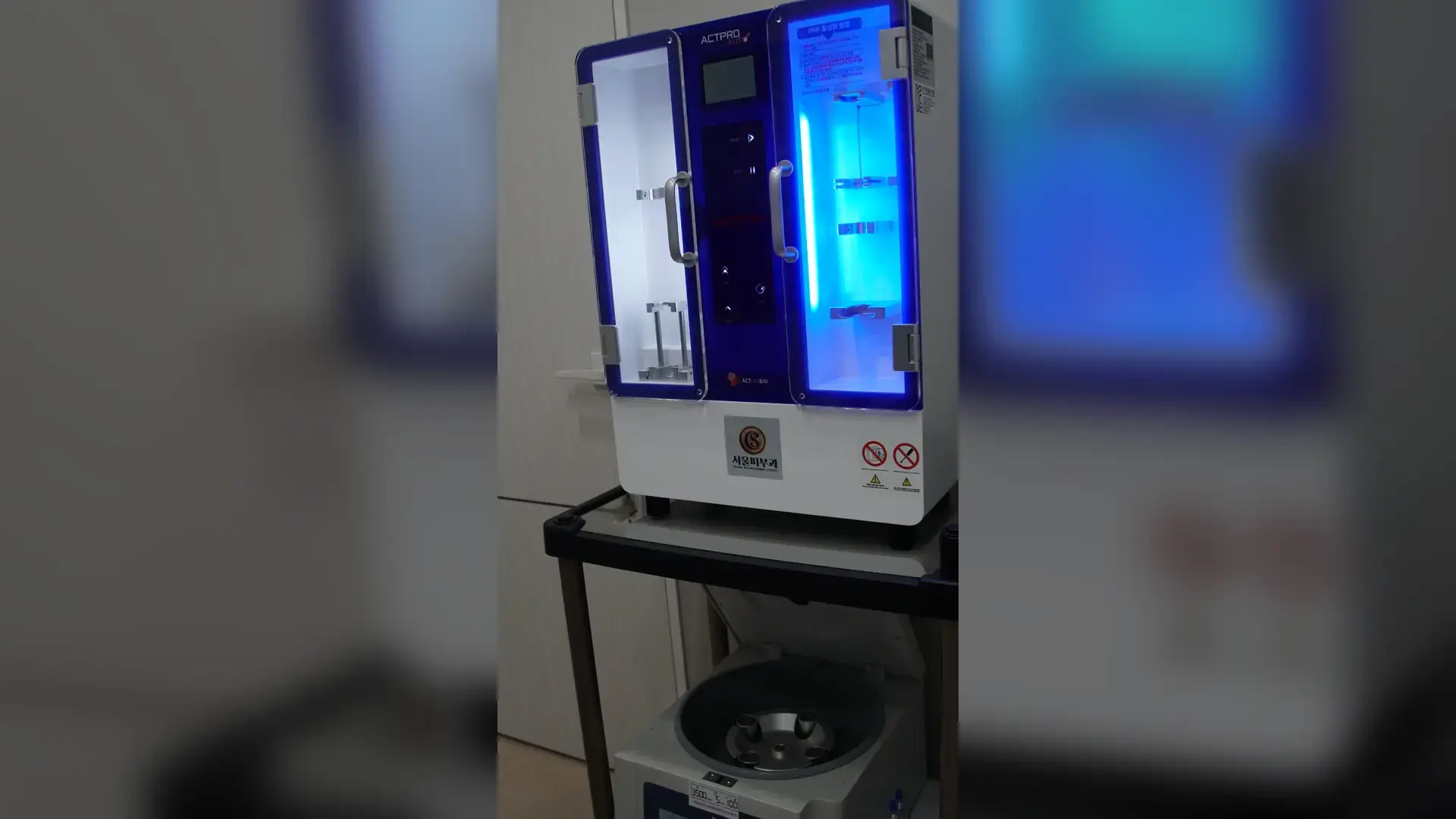
The manufacturer uses ingredients obtained from his own blood. Activation process that involves applying a physical stimulusand describes a manufacturing method that does not use anticoagulants. ACT PRO AUTO is introduced as a blood component activation device used in this process. This is the role of the technology and equipment as explained by the manufacturer. [R08] [R09]
The name ‘active’ alone does not determine the treatment result. When reading papers that study general PRF and injectable PRF, you should check whether the equipment used, manufacturing method, and application area are the same. The PRF clinical study cited in this guide is not a study that directly verified the effectiveness of active PRF made with ACT PRO AUTO. [R03] [R04]
PRP·PRF·Active PRF, let’s start with the names.
| Type | What do you pay attention to? | What you need to understand |
|---|---|---|
| PRP | platelet-rich plasma | Anticoagulants are usually used, and there are various manufacturing and activation methods. |
| PRF/Injectable PRF | Platelet and fibrin structure | Methods of making it without anticoagulants have been studied. There are solid and liquid forms, and injectable PRF has already been studied. |
| Active PRF | Manufacturer-guided physical activation process | We interpret the research results of general PRF separately from the clinical evidence for this product/method. |
It is difficult to conclude that PRF is superior to PRP in all situations. Even in clinical studies comparing the two methods, differences were limited to some areas and evaluation points. [R01] [R04]
Comparing the implementation methods in the hospital at a glance
| Type | How Seoul N Dermatology Clinic Works | Points to distinguish when reading a paper |
|---|---|---|
| PRF | Subcutaneous injection — Injected into the tissue beneath the skin. | Intradermal injection studies and subcutaneous injections have different depths. The general i-PRF study did not directly verify the effectiveness of in-hospital active PRF. |
| PRP | Intravenous administration — Prepared ingredients are re-administered intravenously. | A distinction is made between studies injected directly into the skin, scalp, or joints and studies administered intravenously. |
The choice between the two methods is not determined solely by name or growth factor value. Check the purpose of application, health status, scope of evidence, and precautions.
03. How should I understand intravenous PRP injection?
In-hospital PRP is administered again intravenously.
This method involves collecting your own blood, preparing the necessary ingredients, and then re-administering it intravenously. At Seoul N Dermatology Clinic, PRP is generally administered intravenously, and PRF is administered subcutaneously.
What is the activation of ‘Active PRP’?
Activation refers to the process of inducing the release of signaling substances contained in platelets. The manufacturer introduces ACT PRO AUTO, an active PRP method using physical stimulation. This is material explaining the principles of the equipment and is different from independent clinical trials that confirmed the effectiveness of treatment for specific diseases. [R09] [R13]
Is the PRP skin injection paper also a basis for intravenous injection?
If the route of administration is different, separate evidence is needed to expect the same effect. There are studies of PRP injected directly into facial skin, but the results cannot be translated into the wrinkle and scar improvement effect of intravenous PRP. [R14]
Are there any papers that study intravenous administration?
There are safety observations and early clinical studies addressing intravenously administered autologous PRP (aaPRP). However, the studies introduced below used products that removed clots after calcium activation, and reported little or no final platelets. It cannot be considered the same agent as in-hospital physical activation. [R11] [R12]
Currently, it is difficult to provide guidance on the skin improvement, anti-aging, and chronic fatigue effects of intravenous PRP as established based solely on the evidence confirmed in this guide. Check with your clinic about what purpose you are considering and whether there are any materials and other treatment options that suit that purpose.
View subjects, results, and limitations of intravenous PRP research · Side effects and health conditions to check
04. How do I receive active PRF/PRP consultation for each skin concern?
Depending on whether you are concerned about changes in skin texture, fine wrinkles, sunken scars, or sagging, We provide consultation on the role of active PRF and other skin treatments. You can also check the principles and selection criteria for each treatment in the related guide below. This is not a list that proves the skin improvement effect of intravenous PRP, and PRF must also consider the difference between the injection method in the paper and in-hospital subcutaneous injection.
Skin texture, fine wrinkles, and loss of elasticity — Active PRF and skin injection consultation
Active PRF utilizes your own blood components and can be consulted with the goal of improving skin condition. Small studies of regular injectable PRF have observed changes in some skin markers, but not all wrinkles or sagging. This study did not directly verify the effectiveness of in-hospital activation devices and subcutaneous injections, and responses vary among individuals. [R03]
The difference in moisturizing, skin texture, collagen stimulation, and volume supplementation is Skin Booster/Collagen Booster GuideTake a look together. We compare and provide consultation on the ingredients, purpose, and precautions of Active PRF and each injection procedure.
Pores and pitted acne scars – review of the supporting role of active PRF
Scars are first checked for depth, shape, and presence of tissue pulling under the skin. After evaluating the need for treatment that deals with the scar itself, such as laser or needle radiofrequency, we examine whether there is a basis and purpose for additional consideration of active PRF. PRP parallel studies cannot be explained by the same effect of active PRF. [R05] [R07]
The order in which inflammation, marks, and scars are distinguished is: acne treatment guide, the shape of the pitted scar and the role of each equipment Scar Treatment GuideCheck it out here.
Jawline sagging and cheek volume loss — Distinguish between active PRF and lifting purposes
Skin texture, deep sagging, and volume loss have different treatment goals. The need for lifting equipment is evaluated for jawline and cheek sagging, and the need for treatment to supplement volume is evaluated for volume loss. With Active PRF, we plan to distinguish between skin concerns to be discussed and areas requiring lifting/volume treatment. [R10]
Lifting Selection GuideTake a look at the role of ultrasound and radiofrequency equipment. We do not universally advise that combining active PRF will improve the lifting effect.
If you have atopy, psoriasis, hair loss, or a wound that does not heal well
First, the type and condition of the disease must be diagnosed. The PRF research in the field of skin care on this page cannot be expanded and applied to the treatment effects of other diseases. Manufacturer's examples alone do not explain cure or replacement of existing treatment, and do not stop any medications or treatments you are currently receiving without medical attention.
If you would like to consult about intravenous PRP
Please tell us specifically what changes you expect and what your current symptoms are. If you have fatigue or other systemic symptoms, first evaluate the cause and determine whether the symptoms require appropriate testing and treatment. We do not arbitrarily change the prescription or management of existing diseases.
05. What role does each piece of equipment on the website play?
Equipment that prepares blood components and equipment that delivers energy to the skin have different roles. The information below explains the direction of consultation based on the equipment introduced on the hospital's website. This doesn't mean you have to use all the equipment together or do them all on the same day.
ACT PRO AUTO — PRF/PRP activation process
This is a blood component activation equipment introduced on the website. The manufacturer describes how physical stimulation is applied during the preparation of PRF and PRP. The equipment is responsible for preparing the ingredients, and the in-hospital administration method is PRF subcutaneous injection/PRP intravenous injectionIt is divided into: [R08] [R09] [R13]
During the consultation, check whether this method is appropriate for your skin concerns and what changes and recovery process you can expect.
Scars and skin texture — Praxis and VRO Advance needle radiofrequency
- Praxis (CO₂ fractional): This is a laser that creates fine treatment zones on the skin. Determine whether to apply it by looking at the shape of the sunken scar, rough skin texture, and the time required for recovery.
- VRO Advanced Needle radiofrequency (49 pin): Delivers radiofrequency energy into the skin through a fine needle. This is a device that provides consultation by examining the condition of scars, pores, and skin texture. This is distinct from the ultrasonic lifting function of the same name.
Laser/needle radiofrequency and blood-derived treatments have different approaches. Among studies combining topical PRP and laser, there were results in which no additional benefit was evident and redness and swelling were more severe. This study did not directly verify the combined effectiveness of the device with in-hospital intravenous PRP or subcutaneous PRF. [R05] [R07]
Sagging/looseness — VRO Advance, Oligio, Exilis
The lifting instructions on the website include: VRO Advance, oligio, Exilis etc. are introduced. Ultrasound/radiofrequency equipment delivers counseling by delivering energy to the skin and support layer, and its treatment goals and methods are different from PRF. If deep sagging is your main concern, you may want to get a lifting evaluation first. [R10]
| The change that bothers me the most | Directions to look first | Things to check during PRF consultation |
|---|---|---|
| Rough skin texture, shallow fine wrinkles | Skin condition, presence of dryness/inflammation, previous treatment history | Are blood-derived treatments on target? |
| Dented scars and pores | Necessity of scar treatment such as praxis, V-needle radiofrequency, etc. | Reasons and rationale for additional treatment, burden of recovery |
| Jawline, sagging cheeks | Lifting consultation, including V-Ro Advance | Differentiating the roles of improving skin texture and treating sagging skin |
| looseness of the skin | Radiofrequency consultation such as Oligio and Exilis | Which plan is appropriate: single or step treatment? |
| Persistent redness, itchiness, and oozing | Diagnosis of skin diseases and control of inflammation | Is medical treatment a priority over injections or energy procedures? |
You should also be informed of the possible side effects of each device, such as heat, redness, swelling, pigment changes, burns, and scars. This table is not a clinical table proving the effectiveness of the combination of individual devices and active PRF.
View all procedures and equipment · acne treatment guide · Guide to melasma·pigmented spots·pigmentation
We do not recommend intravenous PRP as a mandatory procedure to enhance laser recovery or lifting effects. Whether to do it in parallel and at what interval is determined based on each purpose and recovery burden.
06. How much evidence does the paper provide for each route of administration?
When looking at research Target, formulation, injection route, comparison groupCheck them together. The data below has been organized for easy reading by distinguishing between basic experiments, local skin injections, and intravenous administration.
PRF basic experiments and local skin injection research
| Research/administration method | What we found | Limitations when applied to in-hospital treatment |
|---|---|---|
| Miron et al., 2017 · Basic experiment [R01] | We compared growth factor release and cellular responses from PRP and injectable PRF. | This is an experiment using blood samples and cells. It does not indicate the actual duration of effect or recovery speed on the skin. |
| Wang et al., 2019 · Skin cell experiment [R02] | The study examined how liquid PRF affects human skin fibroblast activity and collagen formation. | This is not a clinical trial that verified the improvement of wrinkles by injecting people. |
| Hassan et al., 2020 · 11 people · i-PRF in the dermis [R03] | Some skin indicators improved after injectable PRF treatment. | There was no control group and not all indicators improved. The method is different from the in-hospital hypodermic injection/activation equipment. |
| Atsu et al., 2023 · 55 people · Facial topical PRP·PRF [R04] | PRP and PRF were compared, and differences at certain points in time were observed in some indices around the eyes. | This is a nonrandomized study divided by patient preference. This is not a comparative test between in-hospital intravenous PRP injection and PRF subcutaneous injection. |
To connect the implications of research to my practice
There is basic and early clinical research supporting how PRF works. However, there are various methods of making it and there are limitations in the scale and comparison methods of clinical research. It is difficult to give everyone the same guidance on the size of the expected effect, maintenance period, and number of times required.
The studies presented here are not report cards for any specific active PRF brand. We do not interpret the release time or experimental values presented by the manufacturer as ‘period of skin improvement’ or ‘multiple of treatment effect’.
PRP — studies injected directly into the skin and studies in veins
| Research/administration method | What did you check? | How far can you interpret it? |
|---|---|---|
| Alam et al., 2018 Randomized comparison of intradermal PRP [R14] | 27: people registered, 19 analyzed. PRP and saline solution were compared on both sides of the face. There were no significant differences in dermatologists' assessment of photographs. | This study concerns local skin injections. It does not provide evidence of skin improvement from intravenous PRP. |
| Karina et al., 2021 · Observation of the safety of intravenous aaPRP [R11] | Medical records of 611 patients, totaling 4,244 doses administered, were retrospectively analyzed. The investigators reported that no relevant adverse events were observed. | This was a recorded analysis without a control group, and effects were not objectively assessed. Because it is the result of a separate preparation containing few platelets, it does not prove the effectiveness or incidence of side effects of in-hospital procedures. |
| Karina et al., 2021 · 10 severe COVID patients [R12] | This is an initial single-arm study using intravenous aaPRP in combination with conventional treatment. Inflammatory levels and clinical course were observed. | There was no comparison group and other treatments were also administered. This was not a study that evaluated the skin, fatigue, and anti-aging effects in the general public, and there were no platelets in the final product. |
‘No adverse reactions were reported’ and ‘It is safe for everyone’ do not mean the same thing. The results cannot be directly applied to preparations and injection methods that are different from the study conditions, and additional data are needed to confirm rare risks and long-term effects. [R11] [R12]
The manufacturer's description is provided separately as information to help you understand the technology of the equipment. The vein studies cited in this guide are not clinical trials of active PRP using ACT PRO AUTO.
07. In what order are consultations and procedures carried out?
1. Check your goals and health status
Identify the skin concern you would like to address with PRF or the purpose for which you are considering intravenous PRP. Please also tell us about previous procedures, side effects, diseases, medications you are taking, and any medical history related to anemia, bleeding, or blood clots.
2. Draw blood and prepare necessary ingredients
If it is determined that the procedure is appropriate, your own blood is collected and the ingredients are prepared according to the equipment and method used. Checking your blood and handling it hygienically are important. [R06]
3. Administered through a route determined within the hospital.
PRF is re-administered into the tissue under the skin by subcutaneous injection, and PRP is re-administered intravenously. The purpose and rationale for each method, expected reactions and side effects will be explained, and any discomfort or adverse reactions will be checked during administration.
4. See the reaction and decide your next plan
PRF looks at the reaction and recovery of the treatment area and does not judge immediate swelling as a long-term effect. PRP checks progress and discomfort according to the purpose set in the consultation. The decision to repeat will be made by reviewing the response and evidence.
The amount of blood drawn, procedure time, injection volume, number of repetitions and intervals vary depending on the method of use and health condition. It is not fixed through online guidance alone.
08. Side effects and precautions before and after the procedure
Even if you use your own blood, you need to be careful.
Pain, bruising, swelling, and redness may occur after blood collection or injection. Preventing infection is important when handling and injecting blood. Just because it is autologous blood does not eliminate the possibility of side effects. [R06]
For intravenous injections, final ingredients and health status are checked together.
For intravenous administration, the preparation used, added ingredients, and risks related to allergy, infection, and blood coagulation must be considered separately. Studies on intravenous aaPRP have also evaluated its safety. Safety cannot be guaranteed simply because it is autologous blood. [R11]
Please let me know when consulting
- Anemia, platelet abnormalities, bleeding/coagulation related diseases, history of thrombosis or significant systemic disease
- Antiplatelet drugs such as aspirin, anticoagulants, and medications currently being taken
- Pregnancy, lactation, history of infection, dermatitis, or herpes at the injection site
- Types and timing of previous filler, lifting, laser, and injection procedures, and past side effects
- Experience of dizziness or fainting during blood draw, allergy to anesthetics or disinfectants
These items are information to determine safety and applicability in clinical practice. This does not mean that all taboos are the same. Do not stop taking prescribed medications arbitrarily; check with the prescribing medical staff and the treating medical staff first.
After the procedure, check like this:
Do not press hard or rub the treated area, and be advised when to resume face washing, makeup, exercise, drinking, sauna, and skin care according to the treatment you received. If you have had laser treatment, you must also follow the post-laser care instructions.
If pain or redness worsens, or if heat, pus, or fever occurs, contact the treatment facility. If you experience severe symptoms such as sudden difficulty breathing, chest pain, or fainting during or after administration, immediately notify a medical staff member or seek emergency medical treatment.
This page provides general information to help you understand the procedure. Actual application is determined after face-to-face examination, and there are individual differences in effectiveness, maintenance period, and recovery.
09. Frequently Asked Questions
At our clinic, PRP is administered intravenously and PRF is injected subcutaneously. Subcutaneous injection delivers material beneath the skin, while intravenous injection delivers it into a blood vessel. These are our clinic’s methods, not universal definitions of PRP and PRF.
There is not enough evidence to say they are the same. Studies of PRP injected into the skin have evaluated topical administration. Intravenous administration requires a separate rationale using the same purpose and preparation. [R14]
The venous studies identified in this guide are safety observation or initial studies for certain serious diseases. The anti-aging, fatigue, and immune system improvement effects in the general public cannot be considered as sufficiently proven data, so this is not indicated as an established effect. [R11] [R12]
It cannot be considered the same. The cited venous studies involved preparations that underwent calcium activation and clot removal, with little or no final platelets. The physical activation method and manufacturing process described by the manufacturer are different. Even if the names are similar, the safety and effectiveness cannot be applied as is. [R11] [R12] [R13]
This guide explains ‘active PRF’ and the manufacturer’s ‘active PRF’. There is also an ‘Actis PRF’ notation in the existing equipment category on the website. Rather than judging based on the name alone, it is better to check the actual equipment used and preparation and application methods during a consultation. [R08] [R09]
PRF, described on this page, is an approach that utilizes platelets and fibrin obtained from your own blood. This is not explained in the same way as treatment that involves isolating, culturing, and administering stem cells. [R01]
In the hospital, PRF is administered subcutaneously and PRP is administered intravenously, making it difficult to simply compare superiority or inferiority. The comparative study of PRP/PRF injected locally into the face cannot be considered as a comparative result of the two in-clinic methods. [R04]
There is no guarantee that you will achieve the change you want just once. We provide consultation based on your skin condition regarding changes you can expect, when to check progress, and whether additional treatment is necessary.
It is difficult to give a uniform period due to different manufacturing and application methods and skin conditions. The length of time growth factors are released in the laboratory and the length of time changes are maintained in the actual skin are two different indicators. [R01]
You may feel pain or stinging during the blood collection and injection process, and bruising and swelling may occur afterwards. We will advise you on adjustment methods considering your pain sensitivity and application area. [R06]
It does not take place on the same day in all cases. Skin reaction, presence of inflammation, equipment to be used, and application area will determine whether to perform the treatment on the same day or at intervals. We cannot universally advise that receiving equipment and PRF together will result in better results. [R05]
Depending on the type and depth of the scar, laser, needle radiofrequency, or other scar treatments may be necessary. The appropriateness of PRF treatment alone and the purpose of additional treatment must be discussed separately. [R07]
Melasma, pigmented spots, and post-inflammatory pigmentation have different causes and treatments. The improvement of some skin indicators in the PRF study cannot be interpreted as a treatment effect for all pigment diseases. If pigmentation is your main concern, get diagnosed first. Pigmentation Treatment GuideCheck it out together. [R03]
The evidence on this page alone cannot be said to replace existing treatments. Please inform us of the disease you are currently treating and the medication you are taking, and first confirm the appropriate treatment direction through a medical examination.
It will be helpful if you organize the skin changes you are most concerned about, a list of medications taken, names and times of previous procedures, past side effects, important schedules, and possible recovery periods. Check the cost and expected number of times after your plan is decided.
PRF·PRP, start with the consultation you need
Seoul N Dermatology Clinic performs both PRF and PRP. PRF is administered subcutaneously and PRP is administered intravenously. First, we identify the desired changes and health status, and then explain the rationale and limitations of each method.
If skin concerns are the focus, we also look at the role of laser, radiofrequency, and lifting equipment introduced on the website. If you have any diseases or systemic symptoms that are currently being treated, please let us know during your consultation. Actual application is determined after examination, and effectiveness and recovery vary from person to person.
PRF/PRP consultation · Introduction to medical staff · View all procedures and equipment
Read More Clinical Columns on Active PRF & PRP by Dr. Park Se-young
- Cheongju Acne & Scar Care: Does Active PRF Also Help Modulate Inflammation?
- Cheongju PRF/PRP Ep. 4: Beyond Skin — Systemic Regeneration & Intravenous Activated PRP
- Cheongju PRF/PRP Ep. 3: Calming Facial Flushing, Rosacea & Inflammatory Acne with Autologous PRF
- Cheongju PRF/PRP Ep. 2: Physical Platelet Activation Technology with ACT PRO AUTO
- Cheongju PRF/PRP Ep. 1: What Is Autologous PRF? Fibrin Matrix & Growth Factor Principles
References
Thesis is information about the research subject and the product used. It is not the same as domestic approval or the scope provided by our center.
- [R01]Basic research — Miron RJ et al. Injectable platelet rich fibrin (i-PRF): opportunities in regenerative dentistry? Clinical Oral Investigations. 2017;21:2619–2627. DOI: 10.1007/s00784-017-2063-9. View source
- [R02]Skin cell research — Wang X et al. Fluid platelet-rich fibrin stimulates greater dermal skin fibroblast cell migration, proliferation, and collagen synthesis when compared to platelet-rich plasma. Journal of Cosmetic Dermatology. 2019;18(6):2004–2010. DOI: 10.1111/jocd.12955. View source
- [R03]General i-PRF clinical study — Hassan H, Quinlan DJ, Ghanem A. Injectable platelet-rich fibrin for facial rejuvenation: A prospective, single-center study. Journal of Cosmetic Dermatology. 2020;19(12):3213–3221. DOI: 10.1111/jocd.13692. View source
- [R04]Comparative clinical study of PRP·PRF — Atsu N et al. The Comparison of Platelet-Rich Plasma Versus Injectable Platelet Rich Fibrin in Facial Skin Rejuvenation. Dermatologic Therapy. 2023;3096698. DOI: 10.1155/2023/3096698. View source
- [R05]PRP and laser parallel study — Faghihi G et al. Efficacy of autologous platelet-rich plasma combined with fractional ablative carbon dioxide resurfacing laser in treatment of facial atrophic acne scars: A split-face randomized clinical trial. Indian Journal of Dermatology, Venereology and Leprology. 2016;82(2):162–168. DOI: 10.4103/0378-6323.174378. Please note that this is not a PRF study. This is a skin topical PRP study, not an intravenous PRP study. View source
- [R06]Society Patient Guide — American Academy of Dermatology. Is platelet-rich plasma the secret to younger-looking skin? Information on the PRP process, hygiene, and general post-injection reactions. View source
- [R07]Society Patient Guide — American Academy of Dermatology. Acne scars: Consultation and treatment. We explain treatment selection according to scar type and the role of laser, microneedling, and radiofrequency. View source
- [R08]Manufacturer's technical description — Excelbio. Active PRF. It is used to confirm the product description and is distinguished from independent clinical trial papers. View source
- [R09]Manufacturer equipment description — Excelbio. Blood cell activation device ACT PRO AUTO. This is data to check the role of the equipment. View source
- [R10]Society Patient Guide — American Academy of Dermatology. Many ways to firm sagging skin. Explains the general role of sagging treatment, including ultrasound and radiofrequency. View source
- [R11]Retrospective observation of intravenous aaPRP safety — Karina K et al. Evaluating the Safety of Intravenous Delivery of Autologous Activated Platelet-rich Plasma. Journal of Health Sciences. 2021;11(2):61–65. DOI: 10.17532/jhsci.2021.1276. A preparation with almost no platelets after calcium and light activation. ACT PRO AUTO is not a clinical trial. View source
- [R12]Initial single-arm study of intravenous aaPRP—Karina K et al. Phase I/II Clinical Trial of Autologous Activated Platelet-Rich Plasma (aaPRP) in the Treatment of Severe Coronavirus Disease 2019 (COVID-19) Patients. International Journal of Inflammation. 2021;5531873. DOI: 10.1155/2021/5531873. 10 severely ill patients, not a study on skin beauty effects. View source
- [R13]Manufacturer's technical description — Excelbio. Active PRP. Product description regarding physical activation and intravenous administration, distinguished from independent clinical evidence. View source
- [R14]Randomized comparative study of intradermal PRP—Alam M et al. Effect of Platelet-Rich Plasma Injection for Rejuvenation of Photoaged Facial Skin: A Randomized Clinical Trial. JAMA Dermatology. 2018;154(12):1447–1452. DOI: 10.1001/jamadermatol.2018.3977. This is not an intravenous PRP study. View source